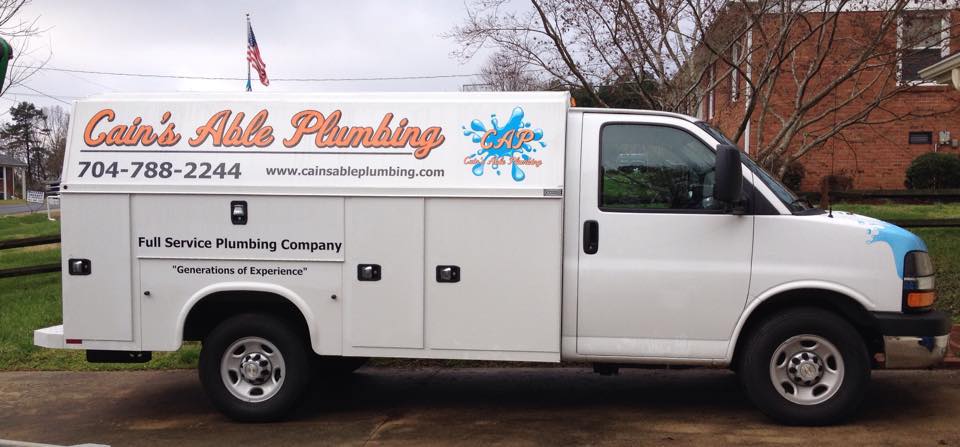
When the Cain truck pulls up, there is a Cain in it!
This google review made my day today. I love the way he said it! Thank you, Jim. 🙂

This google review made my day today. I love the way he said it! Thank you, Jim. 🙂
 Our company is looking to fill the position for a Service Plumber & a Plumber’s Helper.
Must have VALID NC Driver’s License. With clean driving record.
Must have a clean criminal background.
Must be willing to work nights and weekends on a rotating schedule.
You must have transportation to and from work.
4+ years service and repair experience required for Service Plumber position.
Service and repair experience is a plus for Plumber’s Helper position.
Pay is based on experience.
Holidays, Vacation, Sick time offered after 90 day trial period.
Fax resume to 704-934-0031 OR Fill out application on Website www.cainsableplumbing.com/apply-online/
NO PHONE CALLS!
 We are looking to fill a part time position, that could lead to a full time position with our company.
The job includes doing some paperwork, answering phones, scheduling jobs, minor cleaning. We are willing to train the right person. No experience necessary, but must be a quick learner, as well as comfortable and personable on the phone. Some computer experience and data program knowledge is a plus.
NO PHONE CALLS
Apply online at www.cainsableplumbing.com/apply-online/ ONLY.
Due to the storm our phone lines are down. They have been since 2 p.m. Not sure how long they’ll be down for. You can submit work orders or jobs through email. We will get to them as we can. If it’s urgent please mark it as such. Hopefully our phones will be back up soon.
Thank you
Just an announcement about next week for our company. Sept 24th – 28th is a vacation week.
What does this mean?
We will resume business as normal the 1st of October.
Thank you everyone!
Here are some videos of the completed project of two bathroom remodels our guys done recently. The sheetrock work was done by Jack with Handyman Services which also did a great job.
So you have decided to invest in the quality of your drinking water. But, you’re just not sure what it is that you need. Are you on well water, or city water service? Is your water hard, leaving calcium and lime deposits in your shower and toilets? Does your water taste bitter and drinking it is unpleasant? These are all questions to consider when deciding to purchase a water softener, or a water filet, or maybe even both.

Water softeners are generally for reducing the calcium in water. It swaps the calcium ions for positively charged sodium ions. This helps to eliminate the calcium deposits you find in your shower, toilets, dishwasher, etc. However, this does not filter out other harmful contaminants. So while your water may taste better, because calcium can make water taste bitter, it is not necessarily making the water “Healthier” to drink. A water softener is not the choice if your goal is to have cleaner water for drinking, cooking and bathing.
A high quality water filter can do more than remove the calcium from your water. It will remove chlorine and other chemicals that are left behind by the water softener. It can also remove water soluble metals which may be harmful to you. A high quality water filter would be the choice for the best drinking water.
There are also UV filters that can be added to your system to help destroy any bacteria or viruses that may be present in your water. This helps to create the best possible water quality.
Some may choose to create a softener/filter system. Either by installing a water softener, and then to install a filtration system just on their kitchen sink or faucet where they will get their drinking water from. Others will opt to have the water softener and a whole house filtration system combined. Some will go even further and install the UV protection. It is all a matter of what your individual needs are for your home.
The best place to start is to have your water tested for chemicals and minerals and see what results and recommendations you get back. A lot of places will test your water for free. We can help you get that done. Or you can go through your own health department. Usually they will test your water free of charge.
If you find that you have water filtration needs that should be met, please call our office at 704-934-0015, and while we do not sell filtration systems in general, we will be happy to install your system for you. We do supply single phase/filtration devices for refrigerators and sinks. We can help you decide what options would be best for you.
Just a notice to let folks know that our office will be closed on Wednesday July 4th 2018 in observance of Independence Day. If you have an emergency, please give us a call and we will return your call as soon as possible. All other calls will be returned on Thursday July 5th. Have a happy and safe holiday!

A few weeks ago we repaired an underground water leak for one of our clients. A few things that would suggest you may have an underground leak is usual wet spots or pools of water on the grounds surface. If you notice a drop in your water pressure from normal you may want to investigate as this could also be a sign of a leak. Pay attention to your water bill and your monthly water usage because if you have a leak you could see a sudden increase. And remember our guys are here to help if you need a water leak repaired.


Just a note that our office will be closed 5/25/18 – 5/28/18 for the Memorial Day Holiday. We will still be accepting emergency calls.
If you are in need of our services and have an emergency, please call 704-934-0015, and LEAVE A MESSAGE. All calls for URGENT matters will be returned. If you do not leave a message, we will not know that you called. Messages left for non-urgent matters, will be followed up with on Tuesday 5/29/18.
Please have a safe and enjoyable holiday weekend. Don’t forget to honor those who this holiday is to celebrate and thank them for giving up their lives for us and our freedom.